Overview
Start here for mcLogiora 1.0.4 scope, requirements, safety boundaries, and documentation map.
mcLogiora is an open-source multilingual WordPress plugin. It gives site owners explicit workflows for language setup, translation relationships, content, taxonomies, strings, media metadata, menus, widgets, language-aware URLs, multilingual SEO context, review state, and optional suggestions.
Latest stable release
Version 1.0.4 is the current release. It requires WordPress 7.0+ and PHP 7.4+, and is tested up to WordPress 7.1. Manual translation works fully without AI or an external provider.
Product facts
| Field | Value |
|---|---|
| Version | 1.0.4 |
| WordPress.org | Plugin Directory |
| Repository | github.com/mcorucu/mclogiora |
| Release | GitHub v1.0.4 |
| Portfolio | mcorucu.com/en/projects/mclogiora |
| License | GPL-2.0-or-later |
| Requires WordPress | 7.0 or later |
| Requires PHP | 7.4 or later |
| Tested up to | WordPress 7.1 |
| Text domain | mclogiora |
The core boundary
Every translation action is explicit. mcLogiora does not translate automatically, publish automatically, modify source files, delete content, guess a visitor's language, or redirect visitors automatically. Manual translation works without AI or any provider.
What ships in 1.0.4
- Fixed WordPress canonical redirects that stripped configured default-language prefixes from static front pages.
- Preserved prefixed default-language static front-page routing and kept untranslated secondary-language front pages on the documented 404 policy.
- Added regression coverage based on the production routing configuration and improved routing stability under WordPress 7.1.
The 1.0.4 release also includes the capabilities described below from the 1.0.2 public foundation:
- Language setup and management with native names, locale, direction, language codes, and default-language control.
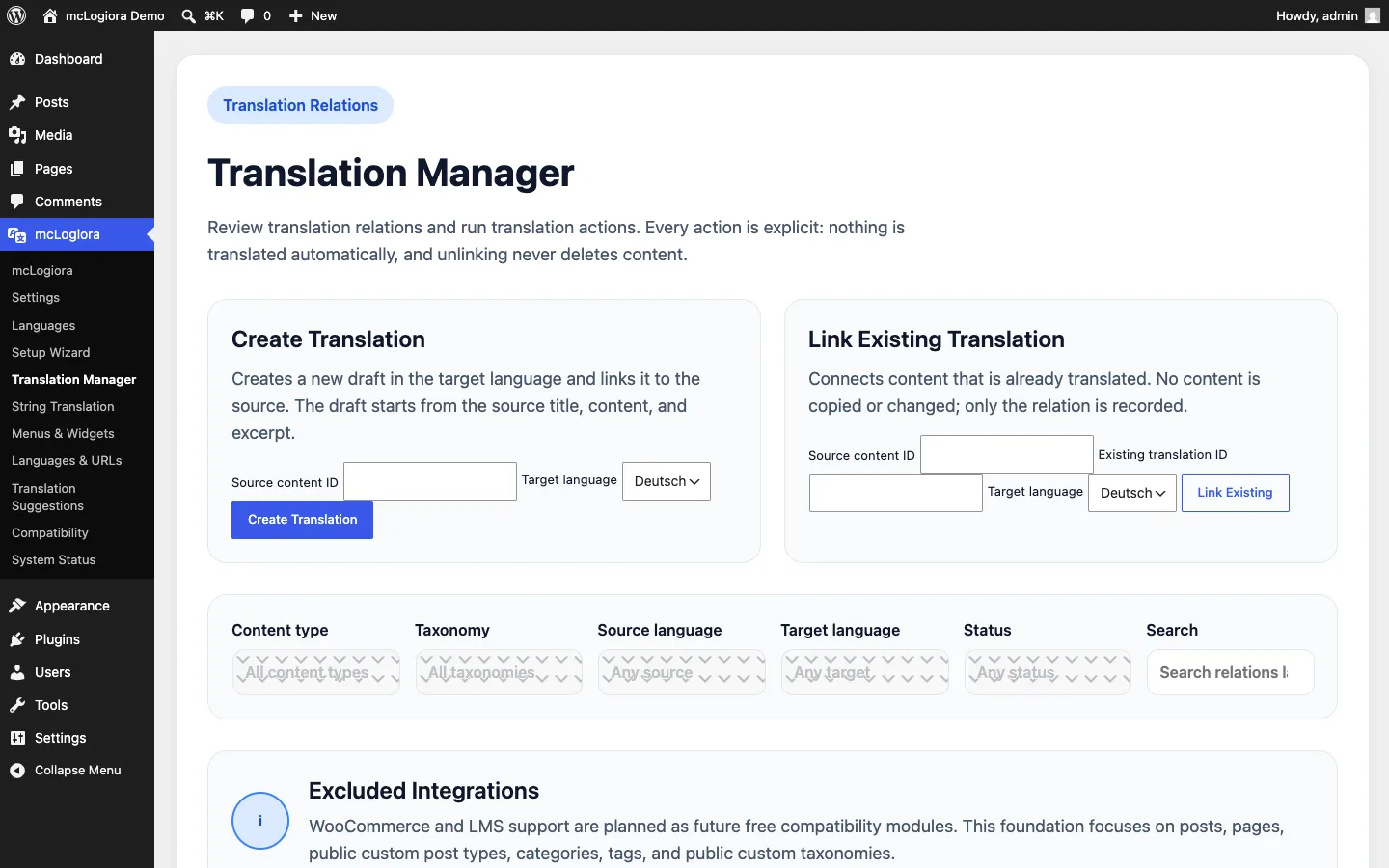
- Translation relationships, Translation Manager workflows, inline content-list actions, and explicit review states.
- Translation support for posts, pages, supported public post types, taxonomies, strings, media metadata, menus, and supported widgets.
- Language-aware URLs, switcher surfaces, and multilingual SEO context including canonical and hreflang integration points.
- Classic Editor, Block Editor, and Elementor compatibility foundations.
- Optional reviewable suggestions through WordPress Core AI Client and Connectors; DeepL remains a separately configured integration where supported.
- Authenticated REST routes for languages, relations, and translations, plus documented PHP functions and
wp mclogioracommands. - Read-only Manual, System Status, Site Health diagnostics, and controlled import/export planning.
Documentation map
Start with Installation, then follow Getting Started, Languages, and Content Translation. Developers should read the Public PHP API, REST API, and WP-CLI pages. Operators should read Diagnostics, Privacy & External Services, and Troubleshooting.